How AI Is Evolving Faster Than We Can Control – And Why Businesses Should Prepare Now
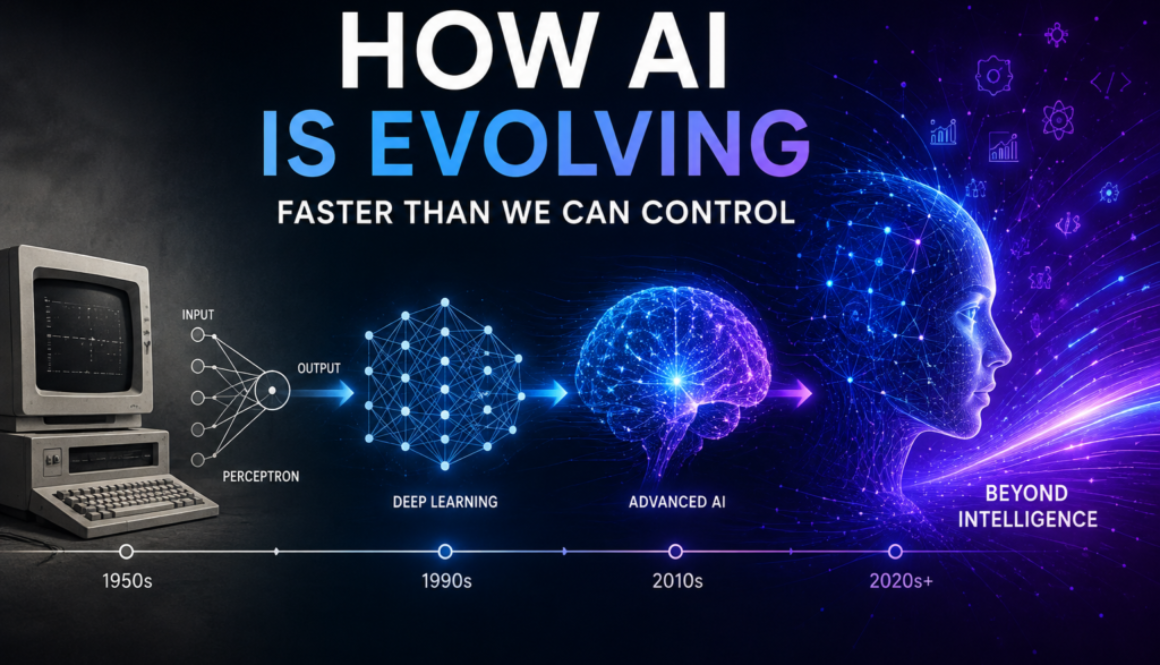
Artificial intelligence has progressed at an astonishing pace, but understanding how AI is evolving requires looking beyond new chatbots, larger language models and impressive product launches. Behind today’s rapid advances lies a surprising reality: most modern AI systems are still based on ideas developed nearly 70 years ago.
As businesses continue investing in AI, understanding where this technology is heading has never been more important.
The Foundation of Modern AI
Back in the late 1950s, psychologist and researcher Frank Rosenblatt introduced the Perceptron—a mathematical model inspired by the way biological neurones work.
The concept was simple:
- Information enters the system.
- Each input is given a weight.
- An output is produced.
- If the answer is incorrect, the weights are adjusted.
This simple learning process became the foundation for what would eventually evolve into modern neural networks.
Today’s AI systems contain billions of parameters and incredible computing power, but they are still sophisticated extensions of that original idea rather than completely new forms of intelligence.
Bigger Doesn’t Always Mean Smarter
For many years, increasing the size of AI models produced remarkable improvements.
More data.
More computing power.
More parameters.
Each generation became noticeably better at:
- Understanding language
- Creating realistic images
- Translating between languages
- Writing software
- Answering complex questions
This led many researchers to believe that simply making models larger would eventually produce human-like intelligence.
Today, that assumption is beginning to show its limits.
The Problem with Today’s AI
Modern AI is incredibly convincing.
It writes fluently.
It explains concepts clearly.
It often sounds highly intelligent.
Yet there is an important distinction.
Fluency is not the same as understanding.
Current AI systems recognise patterns exceptionally well, but they do not truly comprehend the meaning behind those patterns.
This explains why AI can sometimes:
- Produce completely incorrect answers with confidence
- Hallucinate facts that don’t exist
- Struggle with basic reasoning problems
- Fail to understand cause and effect
- Make inconsistent decisions
These aren’t simply software bugs.
They are natural consequences of how today’s AI models are designed.
Pattern Recognition vs Real Reasoning
Humans don’t simply memorise patterns.
We understand relationships.
We recognise why events happen and how one decision influences another.
Modern AI, by contrast, is largely based on statistical prediction.
It predicts what information is most likely to come next based on previous examples.
That approach is incredibly powerful—but it has limitations.
No matter how much data is added, prediction alone does not automatically become genuine reasoning.
The Next Generation of Artificial Intelligence
Researchers around the world increasingly believe that AI’s next breakthrough won’t come from building larger models.
Instead, it will come from entirely new ways of designing intelligent systems.
Several exciting developments are already emerging.
Hybrid AI
Future systems are likely to combine:
- Neural networks for recognising patterns
- Symbolic reasoning for logical thinking
This hybrid approach aims to deliver AI that can both learn and reason more effectively.
Causal AI
One of today’s biggest limitations is understanding why something happens.
Causal AI focuses on learning relationships between events rather than simple correlations.
This could allow AI to:
- Make more reliable decisions
- Explain its reasoning
- Predict the consequences of actions
- Generalise beyond its training data
For businesses, this means AI that is not only more accurate but also more trustworthy.
AI That Learns Through Experience
Today’s models mostly learn from existing datasets.
Future AI systems are expected to learn through interaction.
Whether operating robots, virtual simulations or real-world environments, these systems will improve by acting rather than simply observing.
This approach more closely resembles how humans learn.
Smarter AI Hardware
The future of AI isn’t only about software.
Researchers are developing specialised hardware, including neuromorphic processors inspired by the human brain.
These chips promise:
- Greater efficiency
- Lower energy consumption
- Faster responses
- More autonomous AI systems
Hardware innovation could become just as important as advances in algorithms.
AI as a Scientific Partner
Another major shift is already underway.
Instead of simply analysing information, AI is beginning to assist researchers in discovering entirely new knowledge.
Emerging systems are helping to:
- Generate scientific hypotheses
- Design experiments
- Identify hidden patterns
- Accelerate medical research
- Support engineering innovation
Rather than replacing human expertise, AI is becoming a powerful collaborator.
Why This Matters for Businesses
Many organisations are already seeing both the strengths and weaknesses of today’s AI.
Businesses benefit enormously from automation, content generation and customer engagement, but they also encounter issues with reliability, inconsistency and hallucinations.
As the next generation of AI emerges, businesses that understand these changes will be better positioned to:
- Improve customer experiences
- Make better decisions
- Reduce operational costs
- Build smarter AI workflows
- Stay ahead of competitors
Waiting until these technologies become mainstream may mean falling behind.
How SnobBots Helps Businesses Embrace AI
At SnobBots, we believe AI should be practical, reliable and accessible.
Our AI platform helps businesses automate everyday tasks through intelligent tools including:
- AI-powered website chatbots
- SEO blog generation
- FAQ generation
- Website performance analysis
- AI-powered business automation
As artificial intelligence continues to evolve, businesses need solutions that can adapt alongside it.
Our mission is to make advanced AI simple enough for organisations of every size to use with confidence.
Artificial Intelligence is approaching another defining moment.
For decades, progress has come from making existing systems bigger and faster.
The next leap forward is likely to come from something much more significant—a completely new foundation for machine intelligence.
The organisations that understand this shift today will be the ones leading tomorrow.
The future of AI isn’t simply about more powerful models.
It’s about creating systems that can truly reason, learn, adapt and help businesses solve problems in entirely new ways.