AI Can Now Use a Computer: Here’s What It Can Do
Ask an ordinary chatbot to help you compare hotels, and it might suggest websites, explain what to look for, or organise information you provide. Give a suitably equipped AI agent the same task, and it could navigate the websites, enter your dates, inspect the options, and prepare a comparison. That is the practical appeal of AI computer use. The technology can interact with software interfaces and carry out parts of the work, instead of leaving you to follow a set of instructions. It is an important development. It is also easy to oversell. An AI that can click a button has not suddenly become capable of running every application reliably. Understanding both sides makes the technology much more useful.
What is AI computer use?
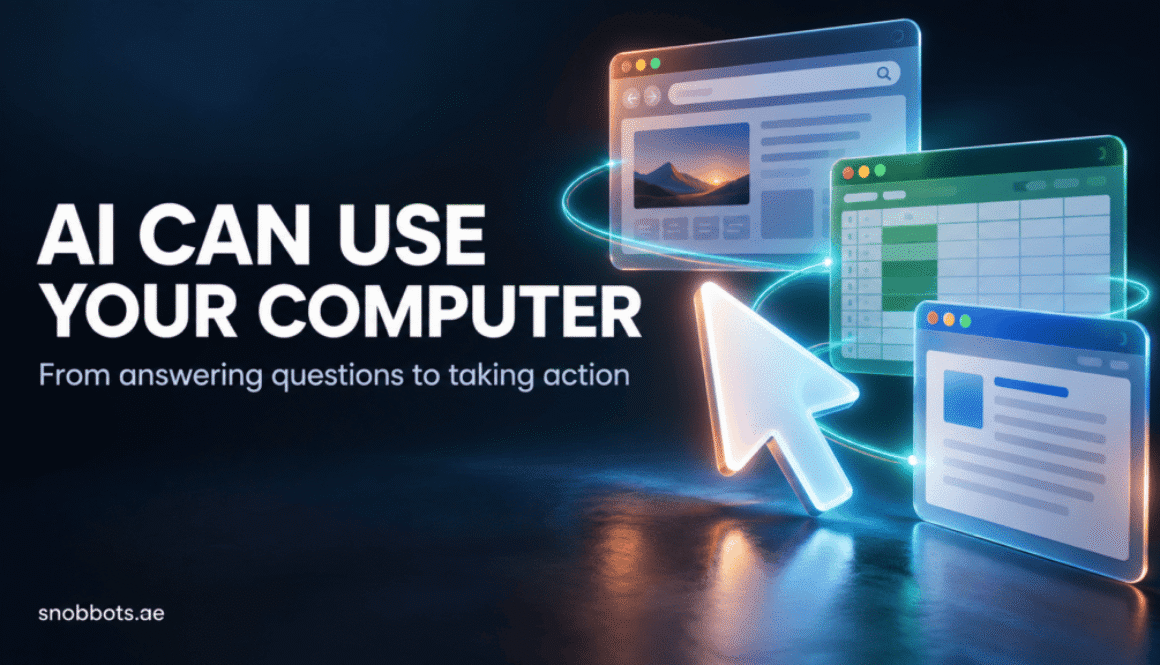
AI computer use gives an AI system tools for interacting with a digital environment. These can include reading screenshots, moving a pointer, clicking, scrolling and typing.
The system examines what is available, chooses an action and checks the result before continuing. Anthropic’s computer-use documentation describes this cycle using screenshots and mouse and keyboard controls in an environment managed by the application developer.
A simple task might involve opening a page, locating a search field, entering a query and reading the results.
A longer task could involve several applications and decisions along the way.
The phrase does not necessarily mean an AI has access to your personal desktop. Depending on the product, it may work inside a dedicated browser, a remote computer or another restricted environment.
Its reach depends on what tools and permissions it has actually been given.
What could you ask it to do?
The most promising examples often involve ordinary digital administration. Useful work does not always make for a dramatic demonstration.
Consider a request such as:
Compare five hotels in London for these dates. Include the total price, cancellation conditions, location and source links. Put the findings in a spreadsheet, but do not make a booking.
With the necessary browsing and file-creation tools, an agent could work through much of that process.
However, success involves more than collecting five prices. It needs to compare the same dates and occupancy, recognise whether taxes are included and avoid mixing refundable rates with cheaper non-refundable offers.
Those details explain why checking the finished work still matters.
Other possible uses include gathering product information, preparing enquiry summaries, entering approved details into forms and testing a website’s booking journey. Each depends on the system’s capabilities, access and reliability.
Why this goes beyond a fixed automation script
Software automation is hardly new. Businesses have used scripts and recorded sequences to complete repetitive tasks for years.
A fixed sequence works well when the process stays predictable. Problems arise when a button moves, a new dialogue appears or the page loads differently.
Computer-use AI can attempt to interpret the situation and choose what to do next. Google’s developer documentation describes computer-use capabilities across supported browser, mobile and desktop environments, alongside configurable safety controls.
That flexibility is valuable, but it introduces uncertainty. A system that interprets an interface can also misinterpret it.
For a predictable task, a direct software connection may still be the better choice. If two applications already exchange data reliably, there may be little benefit in having an AI copy it between screens.
Computer use is particularly interesting where the interface itself is the available route to completing the work.
Where the time savings might come from
Think about the work surrounding a weekly report.
Someone gathers updates from different systems, copies figures, checks which items are missing and assembles a document. The analysis may take less time than collecting everything needed to begin it.
An AI agent could help with parts of that preparation, leaving a person to investigate unusual results and decide what they mean.
A similar pattern applies to incoming enquiries. An agent might organise messages by topic and prepare response drafts, while staff handle exceptions and approve replies.
The benefit depends on the review burden. If every field needs extensive checking, the apparent time saving can disappear.
A useful test is therefore quite practical: does the process take less effort from start to finish, including corrections?
Watching an agent work is interesting. Quietly getting dependable work back is considerably better.
What still causes problems?
A computer interface contains plenty of opportunities for confusion.
Two buttons may look almost identical. A form may save only after an extra confirmation. A session may expire halfway through a task. An unexpected pop-up can cover the information the agent needs.
Login checks, CAPTCHAs and restrictions on automated access can also interrupt progress. Encountering one does not give an agent permission to bypass it.
Long tasks create another difficulty: small mistakes can travel.
If an agent selects the wrong customer at the beginning, the notes and updates that follow may be neatly completed against the wrong record. Finishing all the steps is not the same as finishing the right task.
That is why a useful agent needs to report uncertainty and show evidence of what happened. “Done” should mean more than “I clicked the button”.
Access changes the security question
There is a meaningful difference between an AI suggesting an email and an AI being able to send it.
The same applies to deleting files, changing customer records or submitting a payment. Once a system can act, its mistakes can affect other people and real accounts.
Another concern is prompt injection: instructions placed in a webpage, document or other material that try to redirect the agent away from the user’s request.
For example, a malicious page could attempt to persuade an agent to disclose information it encountered elsewhere. Anthropic explicitly warns about this risk and recommends restricted environments, limited privileges and human confirmation for consequential actions.
The practical lesson is to match access to the job. An agent comparing public product specifications has no obvious reason to access payroll files.
Important controls should be built into the system rather than depending entirely on a sentence telling the AI to be careful.
How to make a first task manageable
Start with a job that is easy to inspect and straightforward to correct.
Researching public information and preparing a comparison is a more manageable starting point than changing live financial records.
Give the agent a clear brief. Specify the sources or applications it should use, the information you need and the required output. Explain which actions need your approval.
For example:
Review these ten product pages and prepare a table of prices, specifications and delivery information. Include a link for every entry. Mark anything you cannot verify, and do not purchase or submit anything.
Then check the result against a sample of the source pages. Look for omissions as well as incorrect entries.
After a few runs, you should have a better idea of where the process works, where it gets stuck and how much supervision it requires.
Expanding from a proven task is more sensible than handing over an entire working day and hoping for the best.
Will AI eventually run whole workflows?
It is possible to imagine an agent gathering information, another analysing it and a third preparing the finished document.
But handing work between agents introduces its own questions. Which source is authoritative? Who catches an error? What happens when two systems reach different conclusions?
Adding more agents does not automatically solve those problems.
A useful long-term direction would be systems that can complete broader tasks while remaining easy to inspect, interrupt and correct. That requires improvements in reliability and control alongside improvements in capability.
The idea of a largely autonomous business remains a much bigger proposition than a successful browser demonstration.
A different relationship with software
For decades, getting something done on a computer has meant learning where the options are and which sequence of steps to follow.
AI computer use offers another possibility: describe the result, provide the necessary access and let the system handle some of the navigation.
That could remove a considerable amount of repetitive work. It could also make software easier to use for people who find complex interfaces difficult.
The standard should remain straightforward. Does the agent complete the intended task accurately, respect its boundaries and make the result easy to check?
If it can do those things consistently, the clicking becomes the least interesting part.