Is Centralised AI Dying? The Rise of the AI Underground
Is Centralised AI Dying? The Rise of Decentralised AI
For years, artificial intelligence has followed a simple formula: build larger models, train them in massive data centres and make them available through centralised platforms. It has delivered remarkable results, but it’s also raised a question that more developers, researchers and businesses are beginning to ask: is centralised AI dying?
The answer isn’t a straightforward yes or no. Centralised AI isn’t disappearing overnight, but a different approach is steadily gaining attention. Instead of relying on a handful of organisations to own the infrastructure, some believe the future of AI could be built on distributed networks where control, computation and even governance are shared.
Why Centralised AI Became So Dominant
The current model makes perfect sense from a technical perspective.
Training today’s large language models requires extraordinary computing power, enormous datasets and highly specialised infrastructure. Keeping everything under one roof allows companies to improve performance, release updates quickly and maintain consistent services for millions of users.
That’s why most of the AI tools we use today run on servers owned by a relatively small number of organisations. They own the models, control the APIs and decide how those systems evolve.
The Trade-Off Nobody Talks About
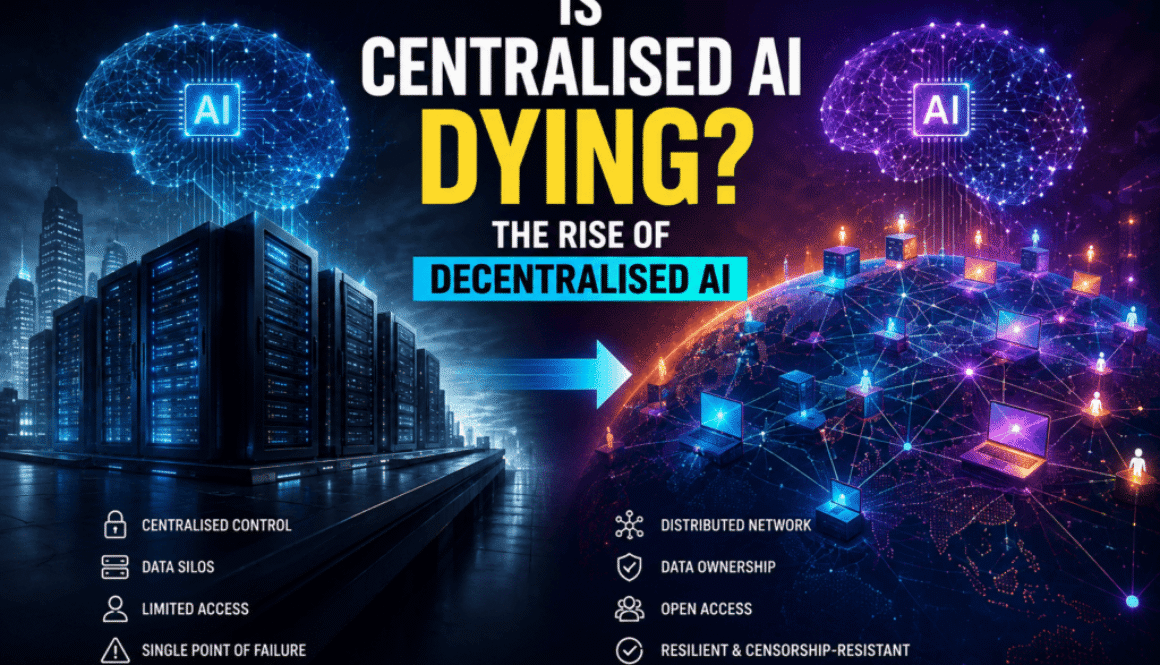
Centralisation brings efficiency, but it also concentrates control.
When one company owns the infrastructure, it can change pricing, restrict access, introduce new policies or remove features with very little notice. As AI becomes part of healthcare, finance, education and business operations, those decisions have a much wider impact than they did just a few years ago.
That growing dependence is one of the biggest reasons developers have started exploring alternatives.
What Decentralised AI Actually Means
Despite the buzz surrounding the term, decentralised AI isn’t simply about running models on different computers.
The goal is to distribute both computation and decision-making across a network instead of placing everything under the control of a single organisation.
Rather than relying on one enormous data centre, many independent participants contribute computing power. Instead of collecting every dataset in one place, technologies such as federated learning allow models to improve while keeping sensitive information on local devices. Some projects also use blockchain-based coordination to verify contributions and reward participants without needing a central authority.
Why Momentum Is Growing
Interest in decentralised AI hasn’t appeared by accident.
People are becoming more aware of how much data they generate, how AI platforms use that information and how much influence a small number of providers now have over the technology.
At the same time, businesses are thinking more seriously about resilience. Relying on one provider for critical AI services introduces risks that range from outages to unexpected pricing changes or policy updates.
Decentralised AI offers an alternative vision where intelligence is distributed rather than concentrated.
Projects Already Building This Future
Several projects are already experimenting with decentralised AI.
SingularityNET is developing an open marketplace for AI services. Ocean Protocol focuses on decentralised data sharing. Fetch.ai is creating autonomous software agents capable of working independently, while Bittensor rewards contributors who provide valuable machine learning outputs across a distributed network.
These projects are still evolving, but they demonstrate that decentralised AI is already moving beyond theory.
It’s Not Without Challenges
That doesn’t mean decentralised AI is ready to replace today’s leading platforms.
Coordinating thousands of independent nodes introduces complexity. Training large models across distributed systems is slower, network latency becomes more significant and protecting against malicious participants is far more difficult.
Centralised AI still delivers better performance for many enterprise workloads.
That’s simply where the technology stands today.
The Future Is More Likely to Be Hybrid
Rather than one approach replacing the other, the industry appears to be moving towards a hybrid model.
Large foundation models may continue to be trained by central organisations, while decentralised networks handle local inference, privacy-sensitive data and community-driven governance.
For businesses, that could provide the best balance between performance, flexibility and control.
Why Businesses Should Care
Artificial intelligence is becoming part of everyday business infrastructure.
Whether you’re using AI to automate customer support, generate content, analyse data or improve decision-making, the way those systems are owned and operated matters.
Understanding the differences between centralised and decentralised AI isn’t just a technical discussion anymore. It’s becoming a business decision that affects privacy, resilience, compliance and long-term strategy.
Where AI Goes Next
So, is centralised AI dying? Not today.
But the idea that artificial intelligence must always be controlled by a handful of organisations is being challenged for the first time at scale.
Decentralised AI is still in its early stages, with significant technical hurdles to overcome. Even so, it’s introducing new ways of thinking about ownership, trust and control. As these technologies mature, the future of AI is likely to be shaped by a combination of centralised performance and decentralised innovation rather than one replacing the other completely.