The UAE’s Hidden AI Projects That Could Amaze the World
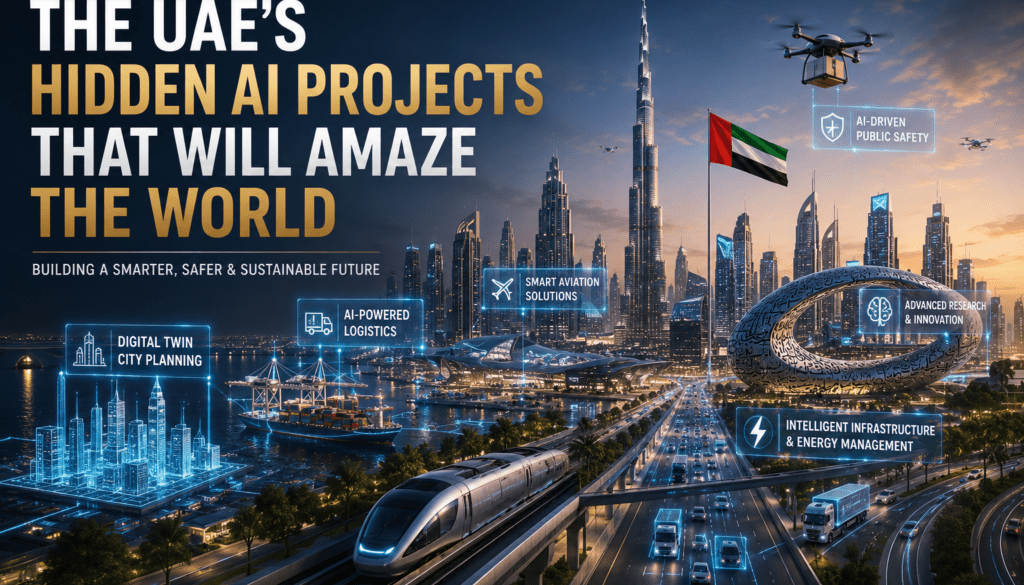
Behind the futuristic skylines and smart city headlines, a quieter transformation is taking place across the Emirates. Many of the most ambitious UAE AI projects are not designed for spectacle or social media attention. Instead, they are being built behind the scenes to strengthen infrastructure, improve sustainability, optimise transportation, support research, and shape a smarter long-term future for the country.
While many nations are still discussing what artificial intelligence might become, the UAE is already integrating AI into the foundations of everyday life. And in many cases, the public only sees a fraction of what is actually happening.
AI Is Becoming Part of the UAE’s Core Infrastructure
One of the most interesting aspects of the UAE’s AI strategy is that much of it operates quietly in the background.
Artificial intelligence is increasingly being used to support energy balancing, traffic management, logistics, public safety, and city-wide operational efficiency. These systems are not necessarily visible to residents day-to-day, but they influence how smoothly modern cities function.
Rather than using technology purely for appearance, the UAE’s approach focuses heavily on practical implementation:
- Smarter infrastructure
- Sustainable urban growth
- Predictive resource management
- Faster emergency response
- Improved transport efficiency
- Enhanced public services
The goal is not to overwhelm people with technology. It is to create environments where technology quietly improves quality of life.
The Rise of Digital Twin Cities
One of the most fascinating developments is the UAE’s growing interest in digital twin technology.
A digital twin is essentially a virtual simulation of a real-world environment. Entire sections of cities can be digitally modelled to help planners test infrastructure changes, analyse traffic flow, improve sustainability, and predict future urban challenges before they happen.
This gives decision-makers the ability to simulate:
- Road congestion
- Energy consumption
- Population growth
- Environmental impact
- Infrastructure resilience
- Emergency response scenarios
Instead of relying purely on estimates, governments and planners can make more informed decisions using real-time AI-driven modelling.
For rapidly expanding cities like Dubai and Abu Dhabi, this kind of technology could become essential over the next decade.
AI Is Reshaping Logistics Across the Emirates
The UAE has long positioned itself as one of the world’s major logistics and transportation hubs. Artificial intelligence is now helping take that system to another level.
AI-powered logistics systems are being developed to:
- Reduce delays
- Improve cargo routing
- Optimise delivery systems
- Predict disruptions
- Improve supply chain efficiency
With global trade constantly increasing, intelligent logistics systems could strengthen the UAE’s role as a central gateway between Asia, Europe, and Africa.
This becomes especially important as industries increasingly rely on real-time data and faster global movement of goods.
Smarter Aviation and Airport Operations
Aviation is another sector where the UAE is heavily investing in artificial intelligence.
Modern airports already process enormous amounts of information every second. AI systems can help improve everything from passenger flow and baggage handling to aircraft routing and fuel efficiency.
Future AI-powered aviation systems may help create:
- Shorter delays
- More efficient flight paths
- Improved safety monitoring
- Faster airport operations
- Better traveller experiences
In a country where aviation plays a major role in economic growth, AI could quietly become one of the biggest forces behind operational excellence.
AI and Public Safety Without Intrusion
One of the more thoughtful aspects of the UAE’s AI development is the emphasis on balance.
The vision described across many initiatives focuses less on surveillance and more on intelligent prevention, preparedness, and support. AI systems are increasingly being designed to improve public safety while minimising unnecessary intrusion into people’s daily lives.
Examples include:
- Predictive crowd flow management
- Smart energy balancing during peak demand
- Faster emergency routing
- Multilingual assistance systems
- Heatwave and weather-response planning
The emphasis appears to be on using AI to make environments safer and more efficient while keeping human judgement central to decision-making.
That distinction matters.
AI Research Is Becoming a National Priority
Across universities, research centres, and technology initiatives, the UAE is investing heavily in long-term AI innovation.
Areas currently being explored include:
- Ethical AI frameworks
- Advanced robotics
- Climate technology
- Smart agriculture
- Quantum computing
- Energy optimisation
- Arabic-first AI systems
This investment is helping position the UAE as more than just a consumer of technology. It is gradually becoming a contributor to global AI development itself.
Arabic-language AI development is particularly significant. As AI systems continue to expand globally, language accessibility will become increasingly important. Arabic-first AI models could help unlock digital opportunities for millions of people across the region.
The UAE’s Approach Feels Different
What separates the UAE from many other countries is the speed at which ideas move from concept to implementation.
The country has repeatedly shown an ability to adopt emerging technologies faster than larger nations weighed down by bureaucracy and slower infrastructure systems.
That does not mean every AI initiative will succeed exactly as planned. But it does mean the UAE has created an environment where experimentation, innovation, and rapid deployment are actively encouraged.
And that creates momentum.
AI in the UAE Is About Capability, Not Hype
The most interesting thing about the UAE’s hidden AI projects is that many of them are not built around flashy marketing.
They focus on solving practical problems:
- Better city planning
- Faster transport systems
- More resilient infrastructure
- Improved sustainability
- Smarter healthcare support
- Stronger logistics networks
- Safer public environments
Much of this progress happens quietly.
Residents may not always see the AI itself, but they will experience the results through smoother services, faster systems, safer cities, and more efficient daily life.
That may ultimately become the UAE’s biggest advantage in the global AI race.