Small Businesses Don’t Need Big Data Anymore
adminArtificial Intelligence, SME AI Chatbots, AI for SMEs, AI Productivity, artificial intelligence, Business Automation, Business Growth, Digital Transformation, Intelligent Automation, Small Business AI, SnobBots
Not long ago, artificial intelligence felt like something reserved for the world’s biggest companies. If you wanted to use AI seriously, you needed vast amounts of data, expensive infrastructure, specialist engineers and a budget that most small businesses simply didn’t have. For years, that created a huge gap between global enterprises and everyone else. Today, that gap is closing. Small businesses don’t need big data anymore. Modern AI has fundamentally changed the way organisations access intelligent technology, making tools that were once exclusive to multinational corporations available to businesses of almost any size.
Why Big Data Used to Matter
The first wave of business AI was built around custom machine learning.
Companies collected enormous datasets, spent months cleaning and labelling information, trained their own models and invested heavily in computing infrastructure. The more data you owned, the more capable your AI could become.
That approach naturally favoured organisations with deep pockets.
For smaller businesses, the barriers to entry were simply too high.
Small Businesses Don’t Need Big Data Anymore Because AI Has Changed
The biggest shift wasn’t that smaller companies suddenly found more data.
It was that the AI itself became available.
Today’s large language models, vision systems and multimodal AI platforms have already been trained using enormous global datasets. Businesses no longer need to build these models themselves—they simply access them through cloud platforms, APIs and AI-powered software.
In other words, you’re no longer building intelligence from scratch.
You’re applying intelligence that already exists.
The New Competitive Advantage Isn’t Data
This changes the conversation completely.
Owning the largest database is no longer the deciding factor for many businesses.
Instead, success depends on how quickly organisations can integrate AI into everyday operations.
Businesses that move faster can automate repetitive work, improve customer service and make better decisions without needing hundreds of employees or dedicated AI teams.
Intelligent Automation Is Levelling the Playing Field
One of the biggest opportunities for smaller businesses is intelligent automation.
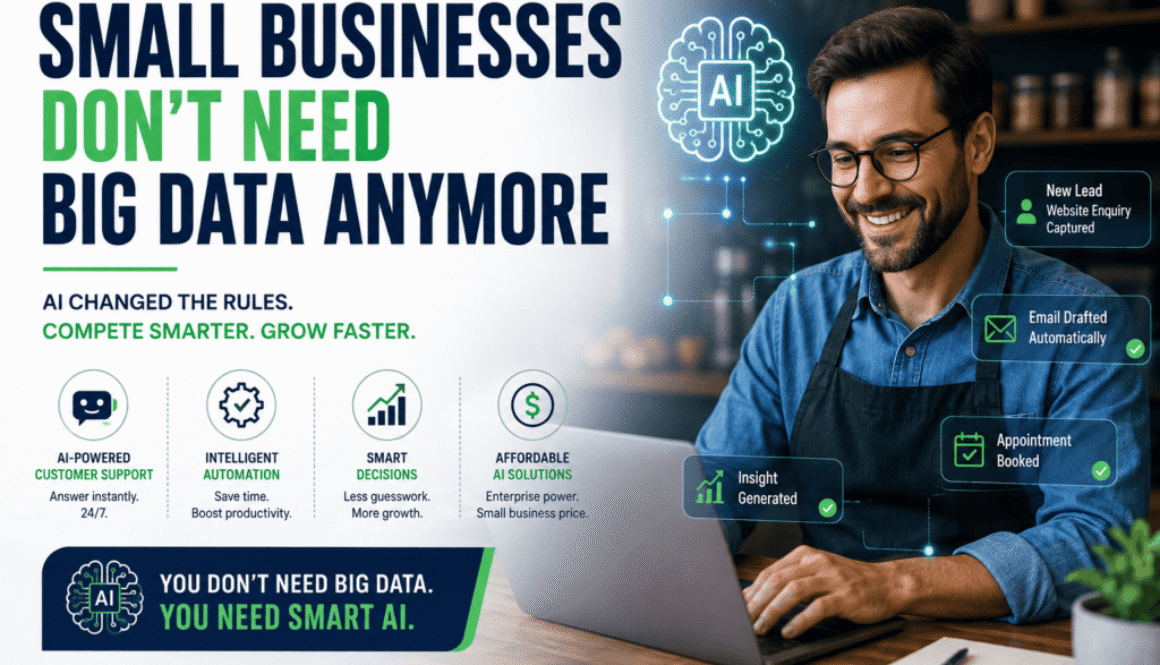
Instead of employees spending hours sorting emails, AI can identify urgency, categorise messages and even draft replies.
Instead of manually processing invoices, AI can extract information, identify anomalies and integrate with accounting systems.
Website enquiries no longer need to wait for office hours either. AI-powered assistants can answer common questions instantly, qualify leads and collect customer information around the clock.
The result isn’t simply faster operations.
It’s giving smaller teams the ability to achieve far more with the same number of people.
Better Customer Service Without a Bigger Team
Customer expectations have changed.
People expect fast responses regardless of whether they’re contacting a multinational company or a local business.
Modern AI makes that possible.
Intelligent chatbots can answer frequently asked questions, guide visitors towards the right service, capture lead information and even book appointments without requiring a large support department.
For many businesses, responding first is often the difference between winning and losing a customer.
AI helps make that possible.
Personalisation Doesn’t Require Massive Datasets
Another common misconception is that personalised customer experiences require years of historical data.
That simply isn’t true anymore.
Modern AI can personalise interactions using relatively small signals, such as pages viewed, time spent on a website, previous enquiries or basic CRM information.
A visitor browsing premium services might receive different messaging from someone looking for entry-level solutions.
These small adjustments create more relevant customer experiences without requiring enterprise-scale analytics.
Why This Matters for Small Businesses
This is exactly where platforms like SnobBots make a difference.
Rather than building complicated AI infrastructure from scratch, businesses can introduce intelligent automation through tools that already exist.
Whether it’s AI-powered chatbots, SEO content generation, FAQ creation or website intelligence, smaller companies can now access capabilities that were once available only to organisations with dedicated AI departments.
AI Is Becoming More Affordable
There’s also a persistent belief that AI is prohibitively expensive.
That may have been true when businesses needed to develop everything in-house.
Today, subscription-based AI platforms allow businesses to adopt enterprise-grade capabilities for a fraction of that cost.
Instead of investing heavily in infrastructure, companies can pay for the tools they need and scale as they grow.
That dramatically changes the economics of AI adoption.
Smaller Businesses May Actually Have the Advantage
Ironically, AI may benefit smaller businesses more than large organisations.
Without layers of management or lengthy approval processes, smaller teams can experiment, adapt and deploy new AI solutions much more quickly.
Large enterprises often spend months evaluating technologies that smaller companies can implement in days.
In a market where speed increasingly matters, that agility becomes a genuine competitive advantage.
Growth No Longer Has to Mean More Overhead
Traditionally, growing a business meant hiring more people, increasing operational costs and expanding internal processes.
AI changes that equation.
As repetitive tasks become automated, businesses can handle more enquiries, serve more customers and improve productivity without increasing headcount at the same pace.
Growth becomes more sustainable because intelligent systems absorb much of the repetitive workload.
Businesses That Act Early Will Benefit Most
Artificial intelligence is no longer something businesses can afford to watch from the sidelines.
The technology is accessible, practical and increasingly becoming part of everyday operations.
The businesses gaining the greatest advantage aren’t necessarily the ones with the biggest budgets. They’re the ones embedding AI into customer service, marketing, lead generation and internal workflows before their competitors do.
Small businesses don’t need big data anymore. They need the right tools, a willingness to adapt and a strategy for applying AI where it creates the greatest impact.
That’s where the real competitive advantage now lies.