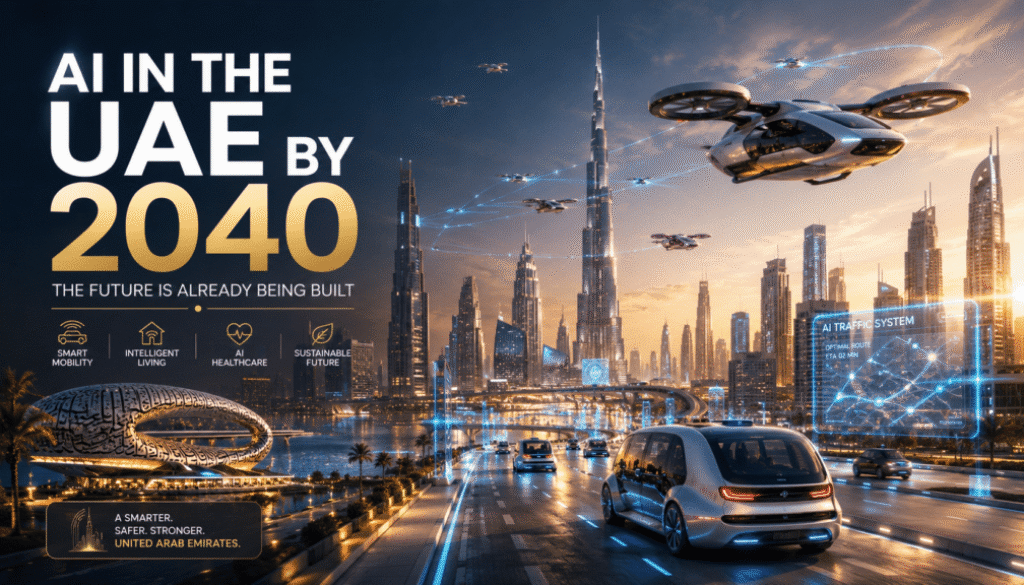
How AI Will Transform Life in the UAE by 2040
The United Arab Emirates has never been a country that waits for the future to happen. It builds it. From record-breaking skyscrapers to smart government services, the UAE has consistently positioned itself at the forefront of innovation. But by 2040, the impact of artificial intelligence in the UAE will move far beyond convenience apps and automation. AI will reshape everyday life, business, healthcare, transport, and even the way people interact with the world around them.
What once sounded like science fiction is already beginning to take shape across cities like Dubai and Abu Dhabi. The UAE is not simply preparing for the future of AI — it is actively engineering it.
The UAE’s Vision for an AI-Powered Future
Unlike many countries that are still debating the risks and opportunities of artificial intelligence, the UAE has spent years investing heavily in emerging technologies. From AI ministries to smart city initiatives, the country is laying the groundwork for a fully connected digital society.
By 2040, AI is expected to become deeply integrated into everyday life across the Emirates. Residents will experience faster services, safer transportation, predictive healthcare, smarter homes, and more personalised digital experiences than ever before.
The goal is not simply to make life more automated. The real objective is to create a society that is more efficient, sustainable, and human-focused.
Autonomous Transport Will Become Normal
One of the biggest transformations will happen in mobility and transportation. The UAE is already testing self-driving vehicles and flying taxis, but by 2040 these technologies could become a normal part of daily life rather than futuristic experiments.
Imagine leaving your apartment in Dubai Marina and summoning an autonomous vehicle that arrives within minutes. No driver. No parking stress. No uncertainty. AI-powered transport systems will analyse traffic in real time, predict congestion before it happens, and automatically reroute vehicles for maximum efficiency.
Flying taxis, which are already being trialled in the UAE today, may become a regular feature of city skylines. Instead of sitting in traffic for an hour, residents could travel across Dubai in minutes through AI-managed aerial transport corridors.
The result will be cleaner cities, reduced traffic congestion, and significantly faster travel times.
Smart Homes Will Understand Human Behaviour
By 2040, homes in the UAE will become intelligent environments that adapt to the people living inside them. AI systems will learn routines, preferences, schedules, and behaviours to create highly personalised living experiences.
Your home may automatically adjust temperature settings before you arrive, prepare lighting based on your mood, or even manage groceries and household supplies without you asking. AI assistants will coordinate appointments, visa renewals, vehicle maintenance, and reminders seamlessly in the background.
This next generation of AI will not feel robotic or intrusive. Instead, it will quietly remove friction from everyday life.
Restaurants, hotels, and retail environments will also become more personalised. Businesses will use AI to understand customer preferences instantly, creating experiences tailored to each individual.
AI Healthcare Will Save Lives Earlier
Healthcare is expected to undergo one of the most significant AI-driven transformations in the UAE.
Instead of waiting for symptoms to appear, future medical systems could detect diseases early through predictive analysis, wearable devices, imaging technologies, and biometric monitoring. AI algorithms will analyse enormous amounts of medical data in seconds, helping doctors make faster and more accurate decisions.
Emergency services will also evolve dramatically. AI-powered traffic systems could automatically clear routes for ambulances, while medical drones deliver urgent supplies to hospitals or accident sites.
This shift toward predictive healthcare could lead to:
- Earlier disease detection
- Faster treatment times
- Improved patient outcomes
- Reduced healthcare costs
- Longer and healthier lives
The UAE’s focus on advanced healthcare technology positions it as one of the leading nations likely to adopt these innovations at scale.
AI Will Transform Government Services
The UAE government has already digitised many public services, but by 2040 AI could automate entire administrative processes.
Tasks such as visa applications, licence renewals, document verification, and legal paperwork may happen almost instantly through intelligent digital assistants. Residents could interact with government systems through voice commands or AI-powered virtual platforms instead of traditional paperwork and queues.
This level of automation would dramatically reduce waiting times while improving efficiency across both public and private sectors.
For businesses operating in the UAE, this could create a far more streamlined environment for growth, investment, and expansion.
Sustainable Cities Powered by Artificial Intelligence
Sustainability is another area where AI is expected to play a major role.
The UAE continues investing heavily in renewable energy, smart infrastructure, and environmental technologies. By 2040, AI systems could optimise energy usage across entire cities, automatically managing electricity, water consumption, waste collection, and transportation networks.
Smart buildings may continuously monitor energy efficiency and reduce waste in real time. AI-powered climate systems could help minimise environmental impact while maintaining comfortable living conditions.
As the UAE expands projects focused on clean energy and smart urban development, artificial intelligence will likely become the invisible engine behind these sustainable ecosystems.
Will AI Replace Human Jobs?
One of the biggest concerns globally is whether AI will replace workers. The reality is more complex.
Some traditional roles will inevitably change or disappear as automation increases. However, AI will also create entirely new industries, career paths, and business opportunities.
The UAE’s approach appears focused on integrating AI alongside human expertise rather than replacing people entirely. Jobs in AI development, cybersecurity, robotics, automation management, digital ethics, and advanced engineering are expected to grow significantly over the next decade.
Businesses that adapt early to AI technologies will likely gain a major competitive advantage.
The Human Side of AI
Despite all the advanced technology, the ultimate purpose of AI in the UAE appears to centre around improving quality of life.
The future being built is not one where machines control people. Instead, AI is designed to work quietly in the background, making life smoother, safer, more personalised, and more efficient.
By 2040, many residents may barely notice AI because it will simply become part of everyday life — seamlessly integrated into homes, transport, healthcare, work, and entertainment.
The future is not approaching slowly. In many ways, the UAE is already living the early stages of it today.