Deepfakes Explained: Why You Can’t Trust What You See Anymore
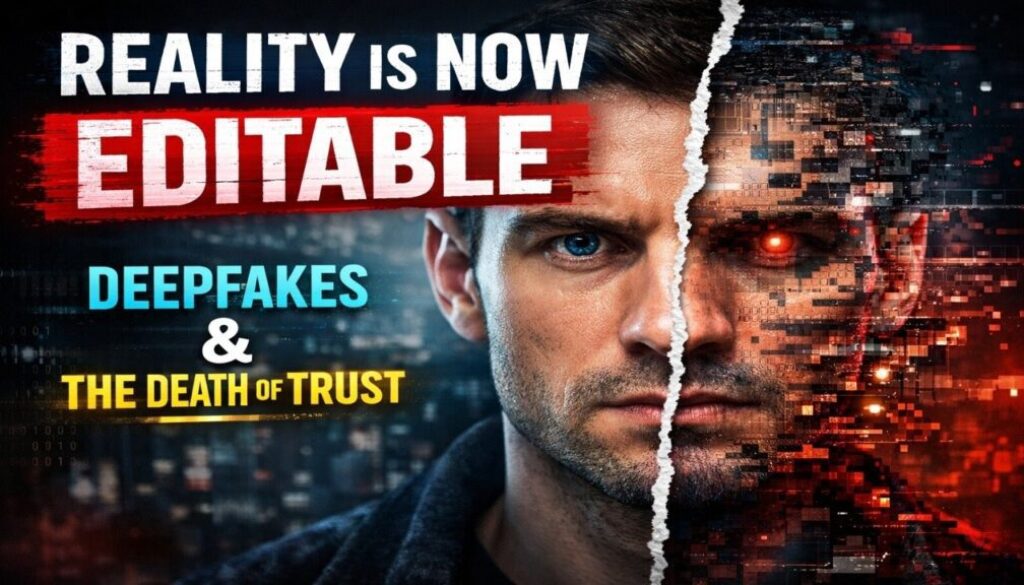
There was a time when video footage felt undeniable. If you saw someone speaking on camera, most people accepted it as proof. That assumption is now collapsing fast. Thanks to rapid advances in artificial intelligence, deepfakes have evolved from internet curiosities into highly convincing digital replicas capable of imitating faces, voices, expressions, and behaviour with alarming realism.
The rise of deepfakes is creating one of the biggest digital trust crises of the modern era. AI-generated content is no longer limited to obvious fake celebrity videos or awkward face swaps. Today’s systems are sophisticated enough to create realistic videos that can mislead audiences, damage reputations, manipulate public opinion, and blur the line between truth and fabrication.
The uncomfortable reality is simple: seeing is no longer believing.
What Are Deepfakes?
Deepfakes are synthetic media generated using artificial intelligence. They use advanced machine learning models to create realistic images, videos, or audio recordings that imitate real people.
Modern deepfake systems can replicate:
- Facial expressions
- Voice patterns
- Lip movements
- Body language
- Eye movements
- Speech timing
- Emotional reactions
What makes modern deepfakes particularly concerning is how realistic they have become. Many are now difficult for ordinary viewers to distinguish from genuine footage. The technology has improved dramatically in just a few years, and the barrier to creating convincing fake content continues to fall.
How Deepfake Technology Works
Early deepfake systems relied heavily on a type of AI architecture known as Generative Adversarial Networks, commonly called GANs. These systems worked using two competing neural networks:
- One AI model generated fake content
- The other attempted to detect whether it was fake
Over time, both systems improved through constant competition, resulting in increasingly realistic outputs. Today’s deepfake systems have evolved far beyond basic face-swapping software. Modern AI models combine multiple forms of data processing simultaneously, including:
- Facial mapping
- Voice cloning
- Behavioural prediction
- Context analysis
- Motion simulation
- Real-time rendering
Instead of simply placing one face over another, modern AI systems attempt to recreate how a person naturally behaves. That includes subtle details such as:
- Blinking patterns
- Speech pauses
- Muscle movement
- Head positioning
- Lighting reflections
- Emotional expression timing
The result can be disturbingly realistic.
Your Online Content Is Training AI
One of the most overlooked aspects of deepfakes is where the training data comes from. Artificial intelligence systems require huge amounts of visual and audio information to create realistic replicas. Much of that data already exists online. Every selfie, social media video, livestream, podcast appearance, or video call contributes to the growing pool of publicly accessible biometric information. In simple terms, many people are unknowingly helping train the systems capable of replicating them. This raises major questions around privacy, ownership, and digital identity.
Who owns your face online?
Who owns your voice?
And what happens when somebody uses your likeness without permission?
These questions are becoming increasingly important as AI-generated impersonation technology advances.
The Growing Threat of AI Misinformation
Deepfakes are not just entertainment tools. They are becoming powerful instruments for misinformation and manipulation. AI-generated media can now spread across social platforms within minutes, often reaching millions of people before verification processes catch up. This creates serious risks during:
- Political elections
- Geopolitical conflicts
- Financial market events
- Celebrity scandals
- Corporate announcements
- Criminal investigations
False videos or fake audio recordings can trigger public panic, damage reputations, manipulate markets, or influence political narratives.
In some reported cases, AI-generated voice cloning has already been used in fraud attempts involving company executives and financial transfers.
The technology is moving faster than public awareness.
The Rise of the “Liar’s Dividend”
One of the most dangerous consequences of deepfake technology is something experts refer to as the “liar’s dividend”. This happens when genuine evidence is dismissed as fake. As deepfakes become more common, people accused of wrongdoing may simply claim that real footage was AI-generated or manipulated. This creates a serious societal problem. Truth no longer breaks down only because fake content exists. It breaks down because uncertainty becomes permanent. When people stop trusting video evidence entirely, accountability becomes harder to enforce. The result is a growing erosion of shared reality.
Why Deepfakes Are Becoming Harder to Detect
Technology companies and cybersecurity researchers are actively developing deepfake detection systems. However, detection tools face a difficult challenge. Every time detection software improves, generative AI systems improve alongside it. This creates a constant technological arms race between:
- AI content generators
- Detection algorithms
- Cybersecurity researchers
- Digital forensic teams
Modern deepfakes can already bypass many traditional verification systems, including certain facial recognition and voice authentication technologies. As AI models continue advancing, spotting fake content manually will become increasingly difficult for ordinary users.
The Future of Digital Identity Verification
Because of these risks, governments and technology companies are now exploring new ways to verify digital authenticity.
Several approaches are already being developed, including:
- Cryptographically signed media
- Blockchain-based verification systems
- Digital watermarking
- AI content labelling
- Biometric authentication upgrades
- Proof-of-personhood systems
The goal is to create systems that can confirm whether content is authentic, when it was created, and whether it has been altered.
Ironically, physical presence itself may become more valuable again in high-trust situations.
In areas such as diplomacy, legal proceedings, financial negotiations, or government operations, face-to-face interaction may increasingly be seen as the safest form of verification.
Are There Any Positive Uses for Deepfakes?
Despite the risks, deepfake technology is not entirely negative.
Like most AI technologies, its impact depends on how it is used.
There are legitimate applications that could benefit society, including:
- Film production and visual effects
- Medical training simulations
- Personalised education tools
- Language translation systems
- Accessibility technologies
- Historical recreations for education
- Ethical digital avatars
AI-generated media could eventually improve communication, learning, and creative industries significantly.
The challenge is ensuring safeguards develop alongside the technology itself.
Why Digital Literacy Matters More Than Ever
The future will not involve eliminating deepfakes completely. Realistically, that is unlikely.
Instead, society will need to adapt by improving:
- Digital literacy
- Verification systems
- Media authentication tools
- Public awareness
- Online critical thinking
People will increasingly need to question content before accepting it as genuine.
That shift represents one of the biggest cultural changes created by artificial intelligence so far.
Deepfake technology is forcing society to rethink some of its oldest assumptions about truth and evidence. For generations, visual proof carried enormous weight. Today, artificial intelligence is making it possible to fabricate highly convincing realities with remarkable precision. The rise of deepfakes is not simply a technology story. It is a trust story. As AI continues evolving, the most valuable thing online may no longer be information itself, but verified authenticity. Because in a world where reality can be edited, trust becomes everything.