The Iran–Israel–US Conflict Is Becoming an AI War (Here’s How)
Modern warfare is changing rapidly, and artificial intelligence is becoming one of the most influential forces behind that transformation. Across ongoing tensions involving Iran, Israel, and the United States, AI is no longer a futuristic concept discussed only in defence laboratories or science fiction films. It is already being integrated into military strategy, surveillance systems, cyber operations, drone technology, and battlefield decision-making.
What makes this shift significant is not simply the existence of AI in warfare, but the speed and scale at which it is changing how conflicts operate. Wars are increasingly becoming data-driven environments where information moves faster than humans can realistically process on their own. Artificial intelligence is now stepping into that gap.
The result is a new kind of warfare — one where algorithms, automation, and machine intelligence quietly influence decisions that were once made entirely by humans.
How AI Is Transforming Modern Warfare
Traditional warfare relied heavily on manpower, physical firepower, and logistical strength. While those factors still matter, modern military operations increasingly depend on information dominance.
Every second during a conflict, enormous volumes of data are generated, including:
- Satellite imagery
- Drone surveillance feeds
- Radar tracking systems
- Intercepted communications
- Cyber intelligence
- Troop movement patterns
- Missile trajectory data
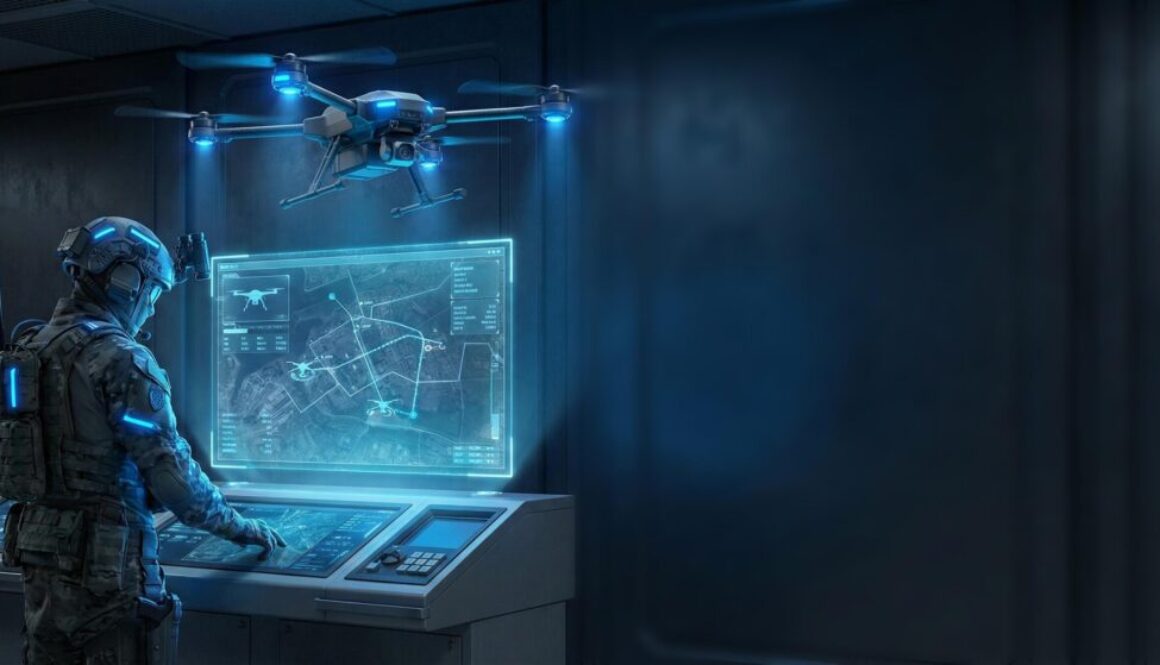
The challenge is that human analysts cannot process this amount of information quickly enough during active conflict situations. AI systems are now being used to analyse data in real time, identify patterns, detect potential threats, and prioritise responses within seconds.
This dramatically changes military decision-making.
Instead of waiting hours or days for intelligence analysis, AI-assisted systems can accelerate the process almost instantly. That speed advantage can become critical during rapidly evolving situations.
AI-Powered Target Identification
One of the biggest developments in AI warfare involves target identification and threat assessment.
Modern AI systems can analyse surveillance data far faster than traditional human-led operations. These systems are capable of recognising movement patterns, detecting unusual activity, identifying military assets, and recommending possible targets.
Importantly, AI systems generally do not make final strike decisions independently. Human operators still remain involved in most military structures. However, AI heavily influences those decisions by narrowing options and accelerating analysis.
This creates a major shift in battlefield tempo.
When intelligence processing becomes nearly instantaneous, military operations naturally move faster. That acceleration increases both operational capability and potential risks.
Experts have repeatedly raised concerns that compressed decision-making timelines could reduce opportunities for verification, discussion, or reconsideration before military action occurs.
The Rise of AI Drone Warfare
Drones have already transformed modern warfare, but artificial intelligence is pushing that transformation even further.
Earlier drone systems relied mainly on remote human control. Today, AI-assisted drones are becoming increasingly autonomous and capable of operating with greater independence.
Some advanced systems can:
- Navigate dynamically in changing environments
- Adjust flight paths automatically
- Recognise objects and terrain
- Coordinate movements with other drones
- Operate in swarm formations
- Identify potential threats in real time
This evolution introduces an entirely new military challenge.
Instead of relying only on a small number of highly expensive weapons systems, military strategies are increasingly shifting toward deploying large numbers of intelligent, lower-cost drones simultaneously.
Drone swarms can overwhelm traditional defence systems simply through scale and speed.
This is one reason AI-powered drone technology has become such a major focus within global defence industries.
AI in Missile Defence Systems
Artificial intelligence is not only used offensively. It is also playing a growing role in defence systems.
Modern missile defence platforms rely heavily on AI-assisted tracking and predictive analysis to respond to incoming threats.
These systems help:
- Detect missiles earlier
- Predict trajectories faster
- Prioritise the most dangerous threats
- Coordinate defensive interception systems
- Reduce reaction times
In high-speed conflict situations, even seconds matter. AI provides military systems with the ability to react faster than purely human-operated structures could manage alone.
As drone and missile technologies become more advanced, AI-assisted defence systems are likely to become increasingly important worldwide.
Cyber Warfare and Artificial Intelligence
Another major battlefield now exists almost entirely online.
Cyber warfare has become a central component of modern geopolitical conflict, and AI is accelerating its capabilities significantly.
AI-powered cyber systems can:
- Scan networks for vulnerabilities
- Detect unusual digital behaviour
- Automate cyber defence responses
- Analyse attack patterns rapidly
- Launch highly targeted cyber operations
In some cases, cyber activity may begin long before any physical military action occurs.
This creates a situation where wars can effectively start in the digital world before becoming visible in the physical world.
Critical infrastructure, financial systems, communications networks, transportation systems, and energy grids all become potential targets within this evolving form of warfare.
AI, Propaganda, and Information Warfare
One of the most concerning aspects of AI warfare involves information manipulation.
Artificial intelligence can now generate realistic images, videos, audio recordings, and written narratives at massive scale. During conflicts, misleading AI-generated content can spread rapidly across social media platforms and online networks.
This creates serious challenges for governments, journalists, and the public.
It becomes increasingly difficult to distinguish between:
- Real footage
- Manipulated media
- Deepfake videos
- AI-generated propaganda
- Fabricated narratives
In modern conflicts, controlling information can sometimes become almost as important as controlling territory.
Public perception influences political decisions, international reactions, financial markets, and civilian morale. AI-powered misinformation campaigns can therefore become strategic weapons in their own right.
The Ethical Concerns Around AI Warfare
The growing use of artificial intelligence in warfare has triggered significant ethical concerns globally.
Critics argue that increasing automation within military systems could reduce human oversight during critical moments. Faster decision-making may improve military efficiency, but it can also increase the risk of mistakes or unintended escalation.
Some of the biggest concerns include:
- Accountability for AI-assisted decisions
- Civilian protection during automated targeting
- Escalation risks from rapid responses
- Reduced human judgement under pressure
- Autonomous weapons development
- International regulation gaps
The debate around AI warfare is still developing, but most experts agree on one point: the technology is advancing faster than global regulation.
Why This Matters Beyond the Battlefield
The technologies being developed for military purposes rarely remain confined to defence sectors forever.
Historically, innovations originally designed for warfare have often influenced civilian industries later, including:
- The internet
- GPS systems
- Satellite communications
- Cybersecurity tools
- Advanced computing technologies
Artificial intelligence is likely to follow a similar path.
The same AI systems improving military data analysis today could eventually influence business operations, healthcare systems, logistics, transportation, cybersecurity, and everyday digital services tomorrow.
That is why understanding AI warfare is not only about military strategy. It is about understanding the broader direction artificial intelligence is taking globally.
Final Thoughts
The ongoing tensions involving Iran, Israel, and the United States are highlighting something much larger than a regional conflict.
They are revealing how warfare itself is evolving.
Artificial intelligence is already shaping military operations through surveillance analysis, cyber warfare, drone coordination, missile defence systems, and information control. The technology is not replacing humans entirely, but it is fundamentally changing how decisions are made, how quickly conflicts escalate, and how modern battlefields operate.
The uncomfortable reality is that AI warfare is no longer theoretical. It is already happening.
And this may only be the beginning.