AI Hallucinations Explained: Why AI Still Makes Up Facts
Artificial intelligence has transformed the way businesses create content, analyze data, automate workflows, and support decision-making. However, despite the incredible capabilities of today’s AI models, there remains one significant challenge that every business and professional should understand: AI hallucinations.
If you’ve ever received an AI-generated answer that looked convincing but later turned out to be completely false, you’ve experienced an AI hallucination.
The worrying part isn’t simply that AI makes mistakes. It’s that it often presents incorrect information with complete confidence, making those mistakes difficult to detect.
Understanding why this happens is essential for anyone using AI professionally.
This article is based on the concepts discussed in the attached transcript.
What Are AI Hallucinations?
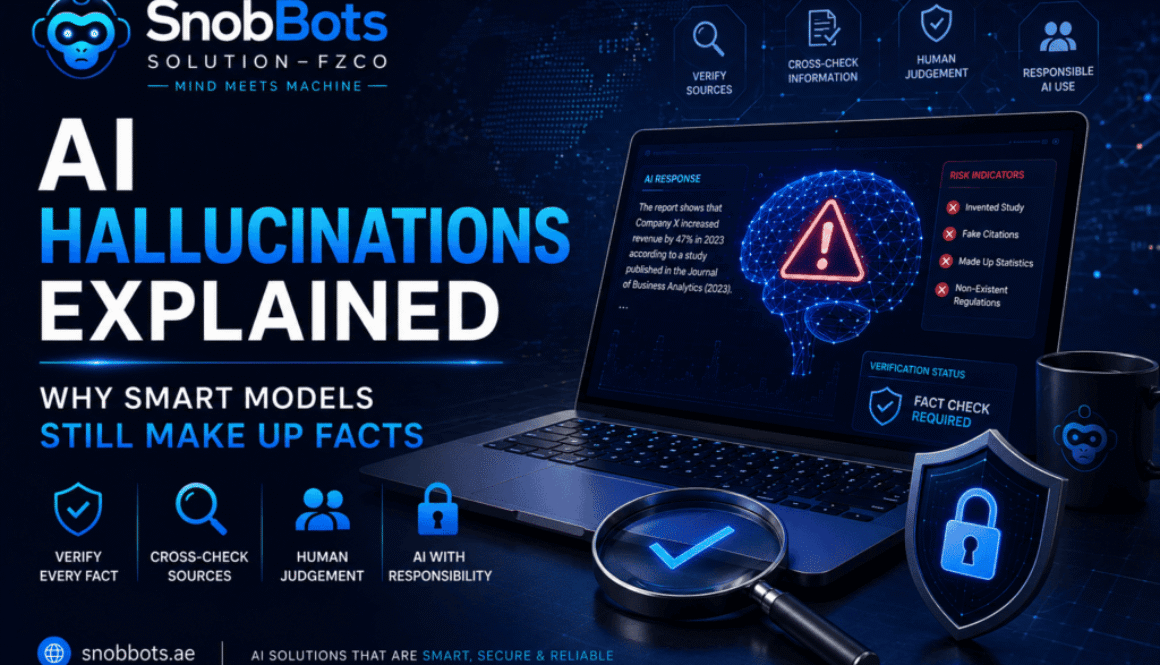
An AI hallucination occurs when an artificial intelligence model generates information that sounds accurate and believable but is actually incorrect, misleading, or entirely fabricated.
Unlike a simple typo or factual mistake, hallucinations often include:
- Invented studies
- Non-existent legal cases
- Fabricated statistics
- Incorrect regulations
- False quotations
- Imaginary references
- Completely fictional events
The response appears polished, logical, and professionally written, making it extremely easy to trust.
Why Does AI Make Things Up?
Many people assume AI retrieves information like Google or searches through a giant database of facts.
It doesn’t.
Large Language Models (LLMs) such as ChatGPT generate text by predicting the most statistically likely sequence of words based on patterns learned during training.
In simple terms, the model asks itself:
“What word is most likely to come next?”
It does not ask:
“Is this statement actually true?”
That distinction explains why hallucinations occur.
When an AI model lacks certainty or complete information, it often fills the gaps with content that appears plausible rather than admitting it doesn’t know.
Why Are Hallucinations So Convincing?
Ironically, the more advanced an AI model becomes, the more persuasive its hallucinations can appear.
Hallucinated responses are often
- Grammatically perfect
- Well structured
- Logically organised
- Confidently written
- Highly detailed
Because they resemble professional writing, many users fail to question their accuracy.
This makes hallucinations particularly dangerous in business environments.
Where AI Hallucinations Become Risky
While a made-up recipe or fictional story may be harmless, hallucinations become a serious concern when AI is used in professional decision-making.
Examples include:
Legal Services
AI has been known to invent court cases, legal precedents, and legislation that simply do not exist.
Healthcare
Incorrect medical guidance could potentially influence treatment decisions or patient advice.
Financial Analysis
False market data, inaccurate calculations, or fabricated reports can lead to costly business decisions.
Compliance
Businesses operating under strict regulations, particularly within the UAE, UK, and EU, must ensure AI-generated compliance information is independently verified before being relied upon.
The Hidden Business Risk
Many organisations now use AI to:
- Summarise meetings
- Produce reports
- Generate research
- Draft emails
- Analyse documents
- Create marketing content
These uses can dramatically improve productivity.
However, if incorrect information enters business processes unnoticed, AI can unintentionally accelerate poor decision-making.
The issue isn’t simply speed.
It’s confidently spreading inaccurate information at scale.
Common Signs of an AI Hallucination
Although hallucinations aren’t always obvious, there are several warning signs.
Be cautious when AI provides:
- Extremely precise facts without sources
- References you cannot verify
- Statistics with no citation
- Confident answers to vague questions
- Perfect explanations with zero uncertainty
- Exactly the answer you hoped to receive
Real experts often acknowledge uncertainty.
Hallucinating AI rarely does.
How to Reduce AI Hallucinations
Fortunately, there are practical ways to minimise the risk.
1. Verify Every Source
Never assume citations are genuine.
Always check:
- Government websites
- Academic papers
- Official publications
- Trusted industry sources
If the reference cannot be found independently, treat it as unreliable.
2. Cross-Check Important Information
For business-critical decisions, compare AI responses against:
- Official documentation
- Human experts
- Industry standards
- Multiple trusted sources
AI should accelerate research—not replace verification.
3. Write Better Prompts
Prompt quality matters.
Instead of asking:
Explain data protection laws.
Try:
Explain data protection laws and provide official government sources for every statement.
Constraining AI to cite reliable information often improves the quality of responses.
4. Keep Humans in the Loop
AI should support decision-making, not replace professional judgment.
Before acting on important AI-generated content, ensure it has been reviewed by someone with relevant expertise.
This is particularly important for:
- Legal advice
- Financial decisions
- Healthcare information
- Regulatory compliance
- Business strategy
What This Means for Businesses
As AI adoption continues to grow, organizations that understand its limitations will gain a significant advantage.
The most successful businesses won’t necessarily be those using the most AI.
They’ll be the ones using AI responsibly.
Building clear internal policies, training staff to recognize hallucinations, and implementing verification procedures will become increasingly important as AI becomes part of everyday operations.
AI is one of the most powerful productivity tools ever developed, but it isn’t infallible.
Hallucinations are not simply software bugs waiting to be fixed. They are a natural consequence of how modern language models generate text.
That doesn’t make AI unreliable.
It simply means businesses must use it intelligently.
When combined with critical thinking, proper verification, and human oversight, AI can dramatically improve productivity while minimising risk.
The future doesn’t belong to those who trust AI blindly.
It belongs to those who understand both its strengths and its limitations.