AI Dating in 2025: Can Artificial Intelligence Really Find Your Soulmate?
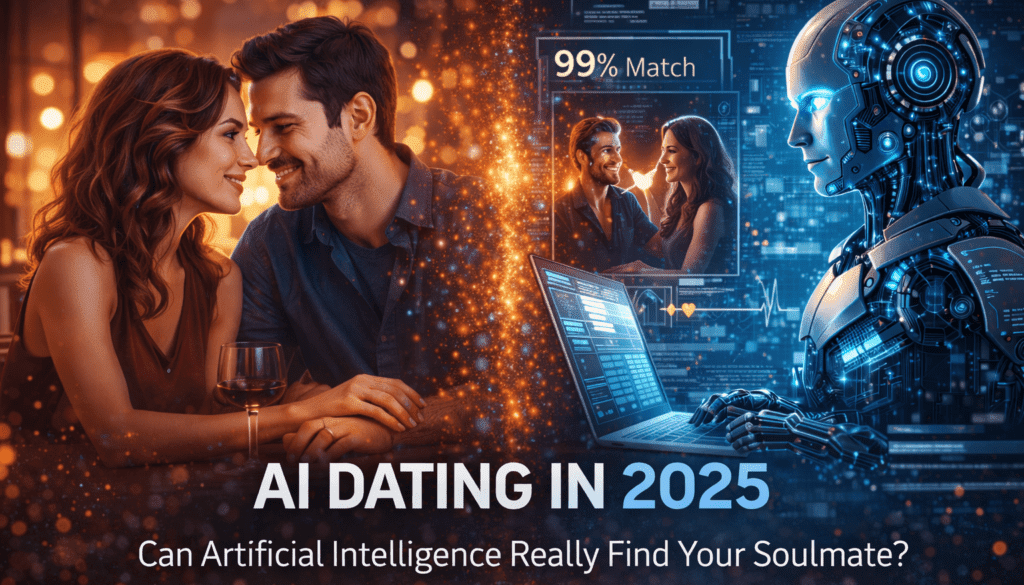
AI dating in 2025 is no longer science fiction. It’s happening right now. Forget endless swiping, awkward small talk, and conversations that fade into nothing. Today’s AI matchmaking systems claim they can predict not just who you’ll like — but who you’ll stay with long term.
Romantic breakthrough?
Or digital dystopia?
Let’s break it down properly.
How AI Dating in 2025 Actually Works
Modern AI matchmaking goes far beyond hobbies and profile pictures.
Traditional apps focused on:
-
Looks
-
Interests
-
Location
-
Basic personality questions
AI dating systems in 2025 analyse far deeper behavioural data, including:
-
Communication patterns
-
Tone of voice
-
Facial micro-expressions
-
Conflict response tendencies
-
Financial decision-making styles
-
Even biometric signals like heart rate variability
Some platforms create what’s known as a “digital twin” — a behavioural map that models your personality, emotional triggers, and long-term compatibility markers.
The goal isn’t just chemistry on the first date.
It’s compatibility five years later.
Predicting Long-Term Compatibility
This is where AI dating in 2025 becomes controversial — and impressive.
Machine learning models train on millions of real relationships, both successful and failed. From that data, they predict:
-
How couples handle stress
-
Whether communication styles clash
-
Emotional resilience under pressure
-
Alignment on life goals
Some systems even simulate potential life scenarios — career changes, financial stress, parenting styles — to estimate relationship durability.
It’s less about sparks.
More about sustainability.
Why People Are Moving Away from Swipe Culture
Swipe-based apps dominated the 2010s and early 2020s. They offered volume, but not depth.
Common complaints included:
-
Dating fatigue
-
Ghosting
-
Choice overload
-
Superficial matches
By 2025, many users want fewer matches — but better ones.
AI dating platforms now often deliver just one or two curated matches per month, backed by compatibility modelling rather than surface attraction.
For many users, that feels like a reset.
Real-World Success Stories
Early adopters report striking results.
Some couples have been matched through shared long-term values rather than appearance. Others through emotional compatibility markers no human matchmaker would notice.
In certain regions, governments facing declining birth rates are even investing in AI-powered matchmaking systems to encourage stable long-term partnerships.
That alone shows how seriously this technology is being taken.
The Privacy Problem No One Can Ignore
Here’s the uncomfortable part.
For AI dating in 2025 to work at this level, it needs deep access to personal data.
That may include:
-
Message analysis
-
Behaviour tracking
-
Health wearable data
-
Emotional response metrics
The obvious question:
How much data is too much?
Critics argue that this level of surveillance risks crossing ethical lines. Regulators in multiple countries are now debating how much information AI matchmaking platforms should legally be allowed to use.
Because when love meets data, privacy becomes deeply personal.
Are We Outsourcing Romance to Algorithms?
Another concern is autonomy.
If an AI tells you, “This is your perfect match,” are you choosing freely? Or are you following algorithmic authority?
Some psychologists warn that over-optimised compatibility could remove healthy friction — the disagreements and compromises that strengthen relationships.
If everything feels “perfect”, does it become fragile?
And then there’s bias. AI models trained on historical data can unintentionally reflect cultural or socioeconomic patterns. Many companies are now implementing bias audits to prevent unfair matching patterns.
But perfection is complicated.
Could AI Become the Partner Itself?
One of the more surprising developments in AI dating in 2025 is the rise of AI companions.
Some users are forming emotional bonds with fully digital partners. This blurs the line between matchmaking and machine companionship.
Is that loneliness solved?
Or something else entirely?
The philosophical implications are only just beginning.
The Future of Love in an AI World
Romance has always evolved with technology — from handwritten letters to online profiles. AI is simply the next stage.
The real question isn’t whether AI dating will grow.
It will.
The question is how we choose to use it.
Used responsibly, AI could:
-
Reduce loneliness
-
Improve compatibility
-
Minimise wasted emotional energy
-
Help people find aligned partners faster
Used poorly, it could:
-
Reduce love to data
-
Infringe privacy
-
Strip away spontaneity
The future of romance sits at that crossroads.
Final Verdict: Should You Trust AI Dating in 2025?
AI dating in 2025 is powerful. It’s predictive. It’s data-driven. It’s sophisticated.
But it’s still a tool.
Love remains human.
AI might help you meet the right person.
But connection, growth, compromise, and emotion? That part is still on you.
Would you trust an algorithm with your heart?


